The Queer Family Cookbook
These are pages from my queer family cookbook
To feed those who hunger for more than just a meal…
The seeds for this,
Were sown in the days we were locked down…
When I had a house in the centre of the city that was open to all
Where we pooled resources and chopped veggies and grated cheese
And cooked food and laughed and cried and made it all better.
For now, this is a collection of recipes and stories.
(and witticisms, because I couldn’t help myself.)
Sourced from my family, undefined by blood.
It’s meant to feed you and those you invite.
(and those who sometimes invite themselves).
Come, let’s eat.
Steps:
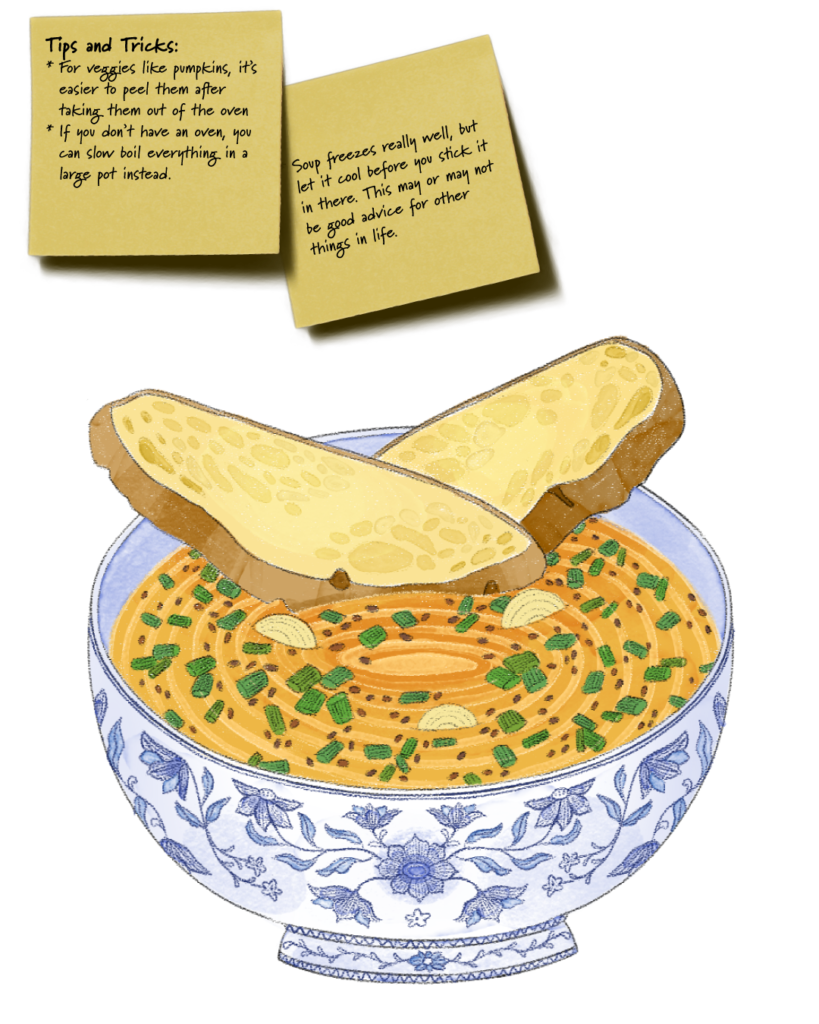
- Preheat your oven to 200-250c
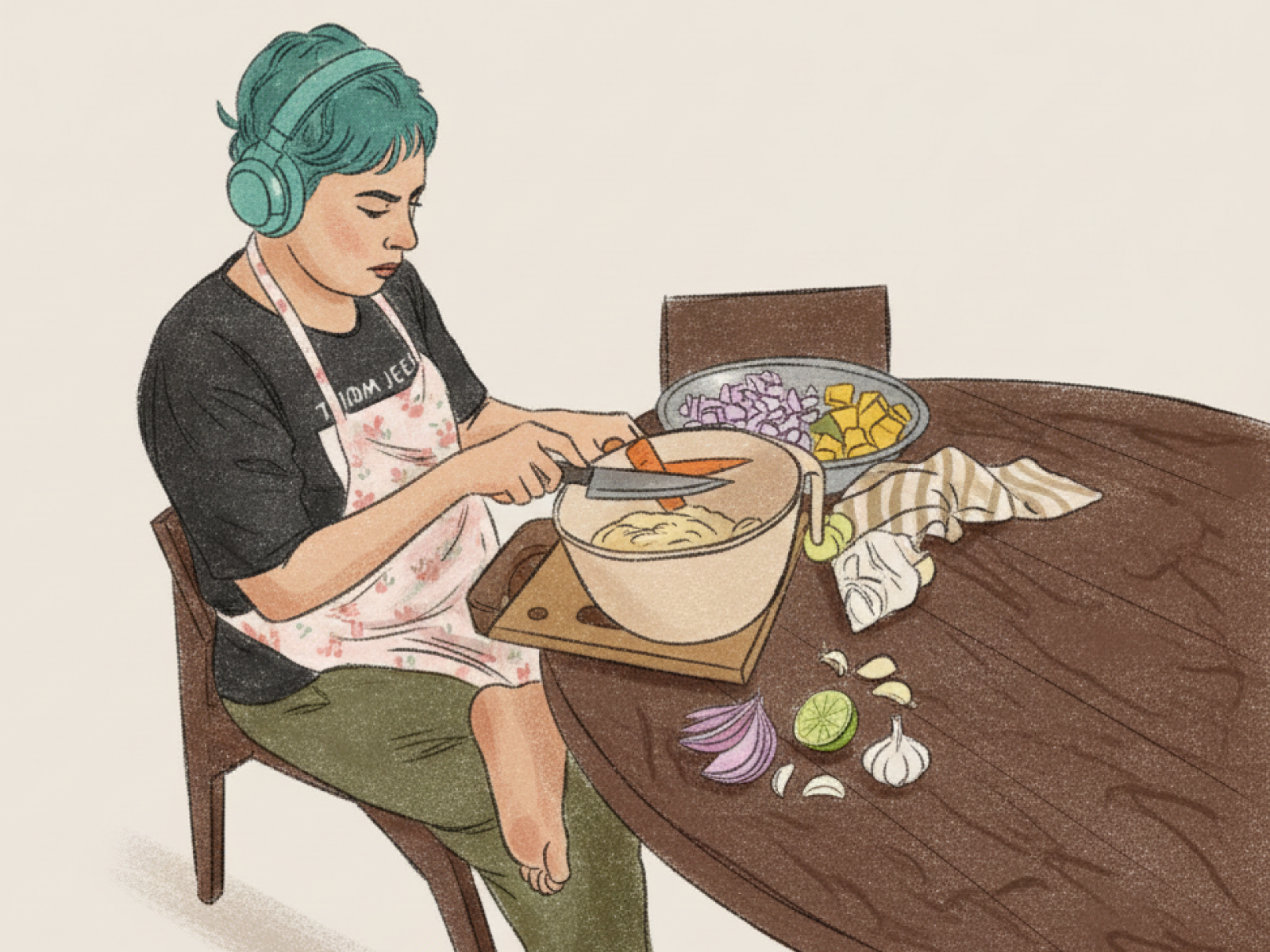
- While the oven warms up, wash all the veggies, especially the root veggies, thoroughly
- Peel and chop them into large chunks, like so (will need an illustration). Even the garlic.
- Slick up a pan with butter and put the veggies on it
- Sprinkle some olive oil and make sure all of the veggies are coated well
- Stick the pan, veggies et all into the oven for about 30-40 mins, or until soft
- Once the veggies are done – they should be squishable between your fingers – start boiling 2 cups of water in a large pot
- Add the yogurt to the hot water and mix till it dissolves. It won’t look very great, but remember looks aren’t everything.
- Add the veggies to the pot – be careful, it’s all hot now
- If you have a hand blender, use it to blend the veggies into the water-yogurt. If a blender is not at hand, use a wooden hand smasher (ghotni) like your ancestors did
- Just like with life, be gentle, but be bold and twist that wrist till you are satisfied with the consistency
- Add your salt, condiments etc now
- Mix the lemon juice with the remaining olive oil and swirl some in when you serve
- For extra yums, serve with a side of butter-toasted sourdough slices
Steps:
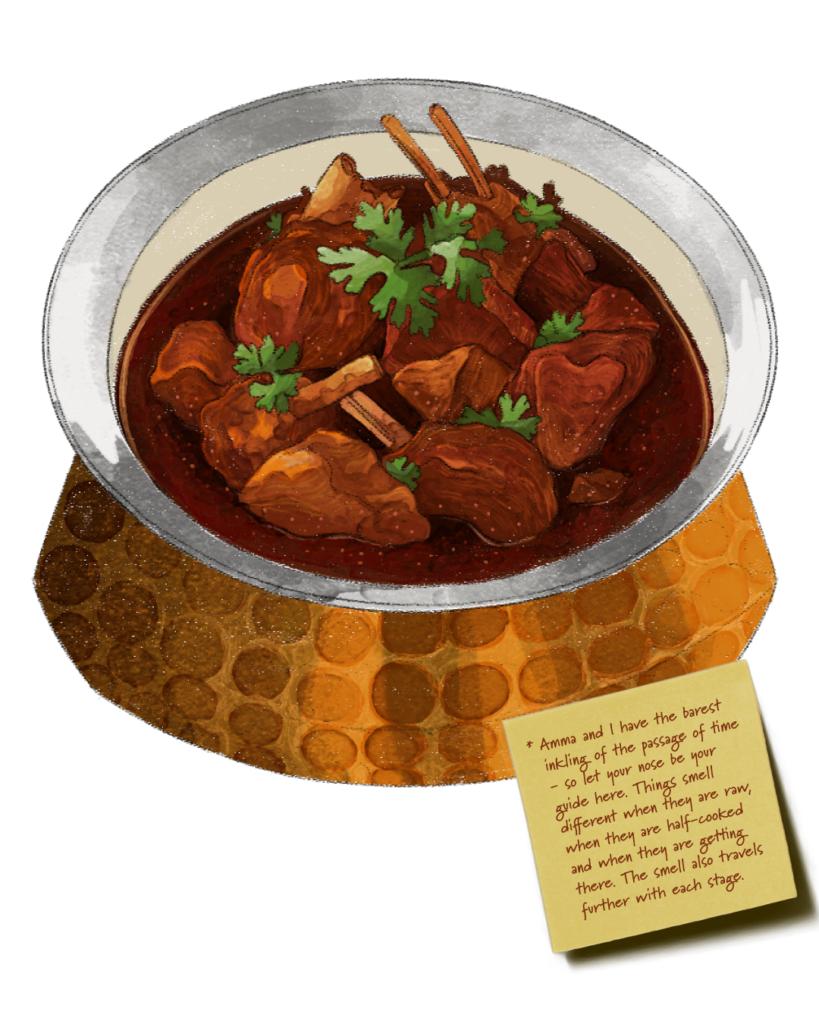
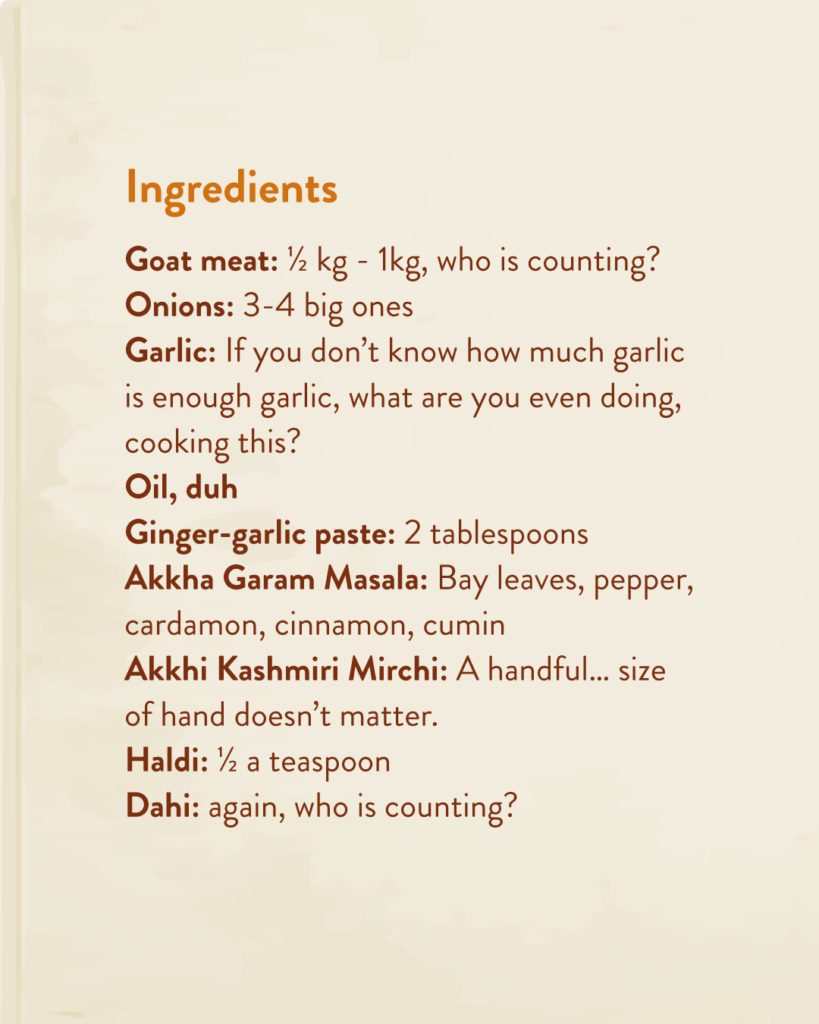
- Soak the chillies in some water for like 30 mins. Use that time to peel the garlic and chop the onions and maybe watch a helpful video on how the chilli was introduced to India by the Portuguese, then introduced to the Mughals by the Marathas nearly two centuries later, who then went on to plant it in Kashmir. If you want to know more, first read this and then read this.
- Grind the chillies, garlic and the garam masala together. I go Neanderthal on this and use a mortar-pestle, a proper hand-made stone one. This process gives you a coarse, rustic paste. Amma says I am stupid and should just get a mixer-grinder. I say she is mean and should gift me one for Diwali.
- Heat the oil in a cooker, or deep-bottomed vessel of your choice. Add the onions and fry until cooked (pinkish-brown, not brownish burnt).
- Add the meat (we are assuming you washed and cleaned it off your own accord). Fry.
- Add salt. Continue frying.
- Add ginger-garlic paste. Fry.
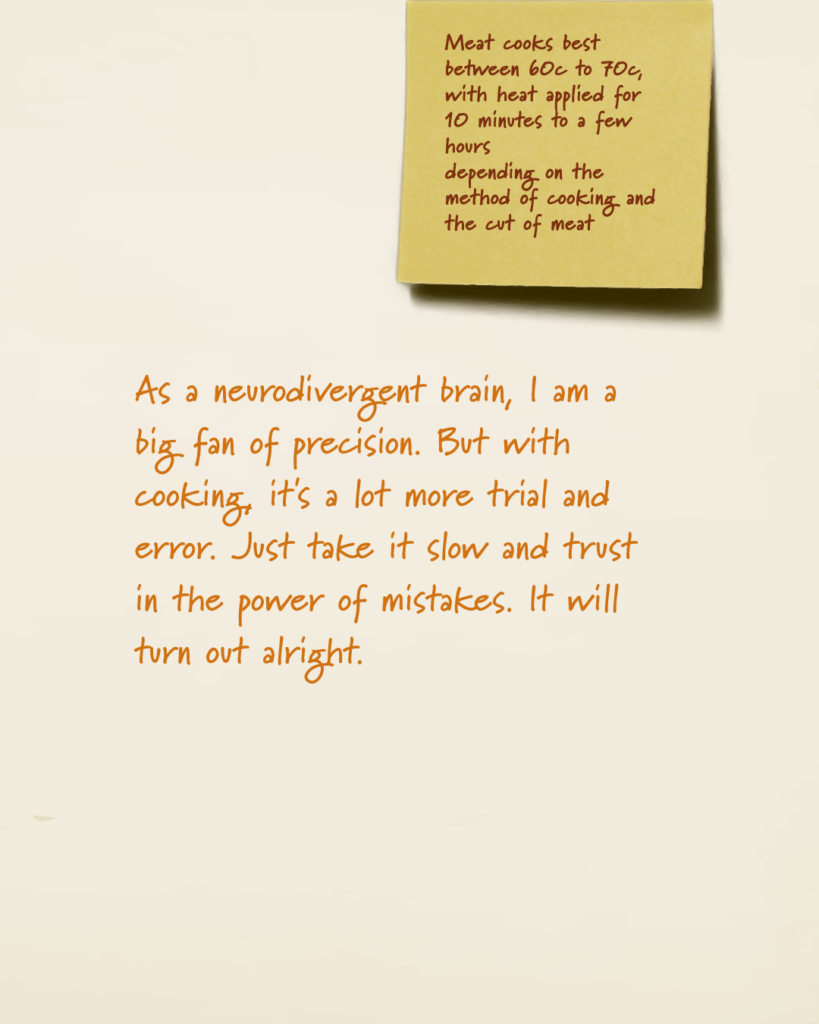
- We are talking a total frying time of 10-15 mins here. Basically till the water released by the meat dries up.
- Add haldi.
- Add a little water, cover and let it do its thing for 10-15 mins more.
- Add the ground chili-garlic paste and, you guessed it, continue frying! Do this till stuff starts to stick to the bottom of the vessel. Hindi main isko bhoon na kehte hai.
- If you are using a pressure cooker, now would be a good time to put the lid on and pressure cook till 4-5 whistles sound.
Amma says, one whistle should be enough. I say Amma is growing old and her memory cannot be relied upon.
- Serve with khameeri roti / crusty bread or rice.
- Add chopped coriander and squeeze a lime on top for max appeal.
Steps:
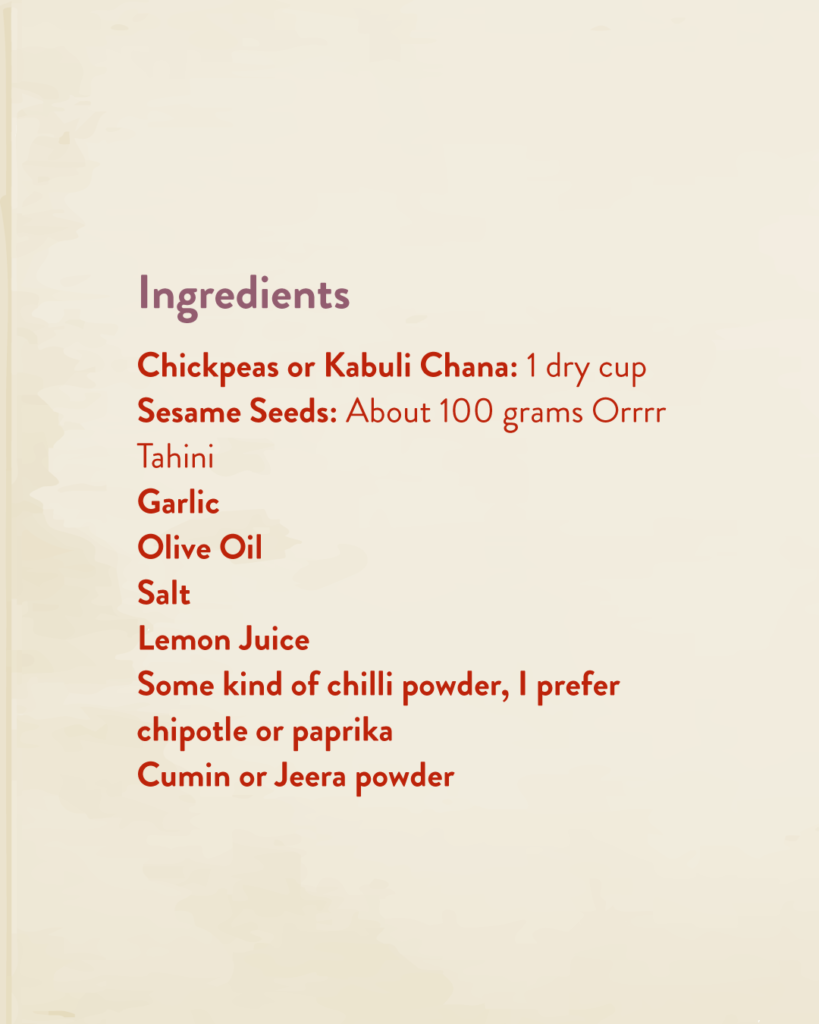
- Soak dry chickpeas for 8 to 10 hours. If you can afford canned chickpeas, proceed to step 3.
- Pressure cook the chickpeas till they are soft and squishable between two fingers. No, I don’t know how many whistles that will take.
- Mince the garlic. You may think that whole garlic pods are fine, since there is a blitzing step involved. But they are not. Mince them.
- Let the boiled legumes cool. Use this time to aesthetically arrange all flavouring ingredients in little bowls that will be a bitch to clean up after this is all done.
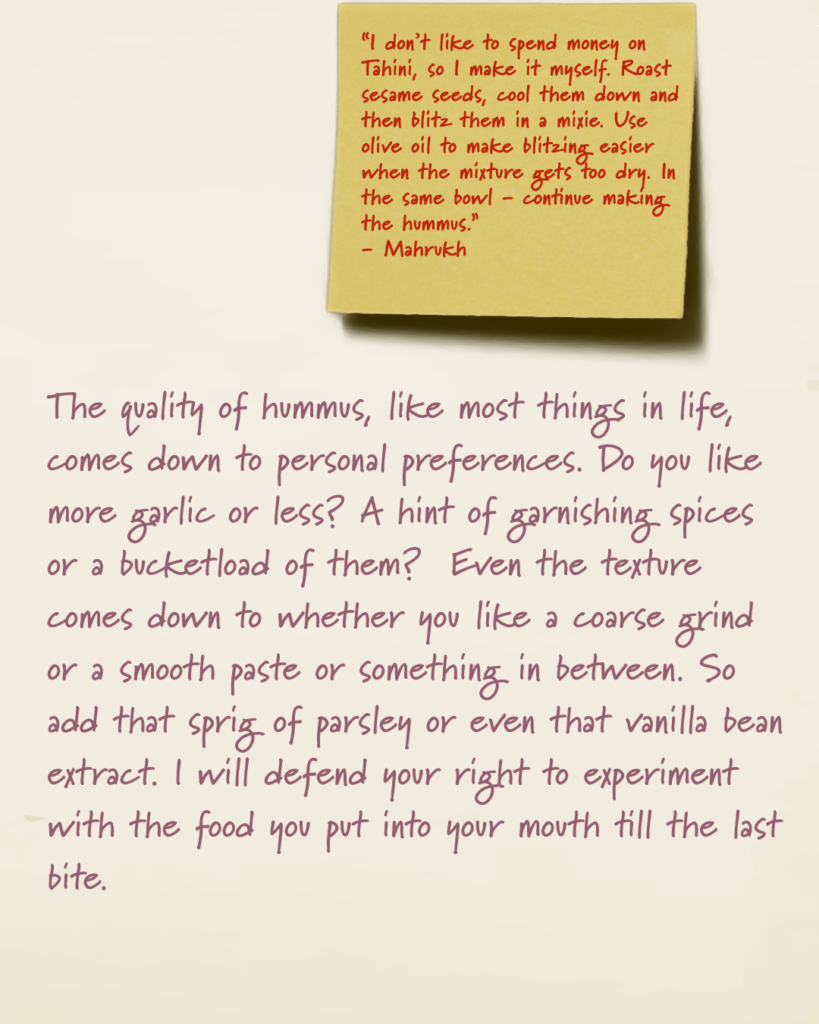
- Choose the blitzing weapon of your choice. Mahrukh being the well equipped cook that she is uses a mixer. Me, being the stubborn fool that I am, I use a hand blender. Put the boiled chickpeas into the bowl with all other listed ingredients. Use freshly ground sesame powder if you want to save money, or be foolish like me and invest in a jar of artisanal Tahini. Blitz till you have the texture you desire. Use water and olive oil judiciously in the endeavour.
- As per Middle-eastern food historians I follow, hummus is traditionally served in a red, wide, shallow bowl which makes it easier to scoop up with a piece of bread or meat. I also love going crazy with sides – carrots, cucumber, dal-vada (Indian falafel), roasted baingan, kebabs, even millet noodles!
To know more about the histories of hummus, fascinating cookbooks from the Abbasid era and the infamous hummus war between Israel and Lebanon, which makes me wish that was the only kind of conflict in the middle-east, read this and then this.
Mahrukh and I would also like to acknowledge the OG recipes of Suzy Karadsheh, founder of The Mediterranean Dish and Blanche Shaheen, author of Feast in the Middle East.

Leave a Reply